Posts

Showing posts with the label Web Development

Ang 2 QS Dependency Tree

Image
Angular 2 | QuickStart | Dependency Tree Here's the Angular 2 QuickStart dependency tree I captured after installing the example project located here: https://angular.io/docs/ts/latest/quickstart.html This is not a good or bad thing, it just is. Since Blogger doesn't seem to let me post PDFs, here's a high resolution PDF of my screen captures of the dependency tree. There's a lot to learn just from browsing through this tree. http:/inventica.com/docs/ang2-qs-dep-tree.pdf
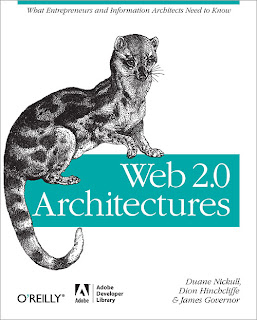
Web 2.0

Image
It's disappointing that the O'Reilly book Web 2.0 Architectures: What Entrepreneurs and Information Architects Need to Know  ( Nickull , Hinchcliffe , Governor ) hasn't received more attention and acclaim. It should have. Too many developers today dive headfirst into programming without first appreciating the 10,000 foot view and a sense of how we got here. As the saying goes:  if you don't know where you came from, then you don't know where you're going. For example, how many developers know that Microsoft's introduction of the XMLHTTPRequest (XHR) object to its Internet Explorer browser is what led to the revolution called AJAX (ignited by Google Maps) , that underlies Web 2.0? Google has also been behind much of the NoSQL innovations that are now fueling Facebook, Amazon, LinkedIn and other Internet giants. Awareness about how major innovations took place in the past is important because it enables the early identification of opportunities for futur...

Enterprise Web Development

Image
[Excerpts from my review published in ACM's Computing Reviews .] Enterprise web development : building HTML5 applications from desktop to mobile Fain Y., Rasputnis V., Tartakovsky A., Gamov V., O’Reilly Media, Inc., Sebastopol, CA, 2014. 642 pp. Type: Book (978-1-449356-81-1) Date Reviewed: Jun 18 2015 A basic truth about this book is that at 600 pages it is ambitious in scope and covers a whole lot of ground. The book defines what it means for an app to be an enterprise app--that it is integrated with one or more company-specific business processes and helps an organization run its business online--and then goes about developing one. The authors have earned their stripes having built and written books on enterprise web apps using Java, then Adobe Flex, and now Hypertext Markup Language 5 (HTML5). HTML5, of course, isn’t just HTML. It’s a replacement term for what used to be called Web 2.0, and is short for the entire tech stack that comprises avant-garde HTML5 d...

Single Page Web Applications

[Excerpts from my book review published in ACM ComputingReviews.com on March 31, 2015.] Single page web applications : JavaScript end-to-end Mikowski M., Powell J., Manning Publications Co., Greenwich, CT, 2014. 432 pp.  Type: Book (978-1-617290-75-6) Date Reviewed: Mar 31 2015 In the late 1990s, a technology now known as Ajax became prevalent in web applications as a tool for fetching content from a web application server asynchronously rather than having to fetch an entire new Hypertext Markup Language (HTML) page whenever a page update was required. The payload format for data exchange between client and server was predominantly Extensible Markup Language (XML) (AJAX was originally an acronym for Asynchronous JavaScript and XML). Typical Ajax use included fetching portions of a page or data updates from a server, the most famous one being Google Maps, which updated its web page asynchronously in response to the user zooming in or out or dragging to a different portion...

Towards a Pixel to Metal Perspective

[This is an excerpt of my review published in ACM's ComputingReviews.com on January 29, 2015.] Becoming proficient at web application development involves a very steep learning curve and is often a never-ending, career-long endeavor. And yet a newbie has to start somewhere. When getting started, it’s easy to become overwhelmed by the vast array of concepts, technologies, and tools one has to master. Often, even proficient web application developers have blinders on when it comes to having a broad perspective on web application development. In general, most developers are adequately familiar with only one or two of the following aspects of web application development: client-side programming, middleware programming, server-side programming, text editors/integrated development environments (IDEs), source/version control systems, data stores, operating systems, network programming, and hardware configurations. Few developers have a broad enough perspective--or what I call a 360-de...

A geek hotline!

Image
31 Tools Every Web Developer Should Know About [A book review of "Web Development Recipes" by Hogan et al. The Pragmatic Programmers. 2012. 321 pp.] This terrific compilation of recipes (42 recipes in 300 pages) is akin to having 24/7 access to a bunch of super-geeks who have found the time you wish you had to explore every promising new web development technology out there. Moreover, the authors have prepared a nice little recipe (generally under 5 pages) for each idea that is worthy of further attention. For the most part, you can skim through the book in any sequence. And you can either read or try out the recipes. I actually tried a few on my web sites (e.g. recipe #3) and they do work! And there's good thoughtful cross-referencing between recipes, pointing out prerequisites and ideas for further exploration. Even if you're not motivated enough to try out all of the book's recipes, skimming through this book is the best way I can think of to develo...